Core Factors Makes Special Reports on EQ, Communication, and Career Development Free to Download
Core Factors Special Reports on emotional intelligence, workplace communication, and career development are now free
Press Release Disclaimer: This is a press release distributed through the XPR Media network. It has not been independently verified by our newsroom.
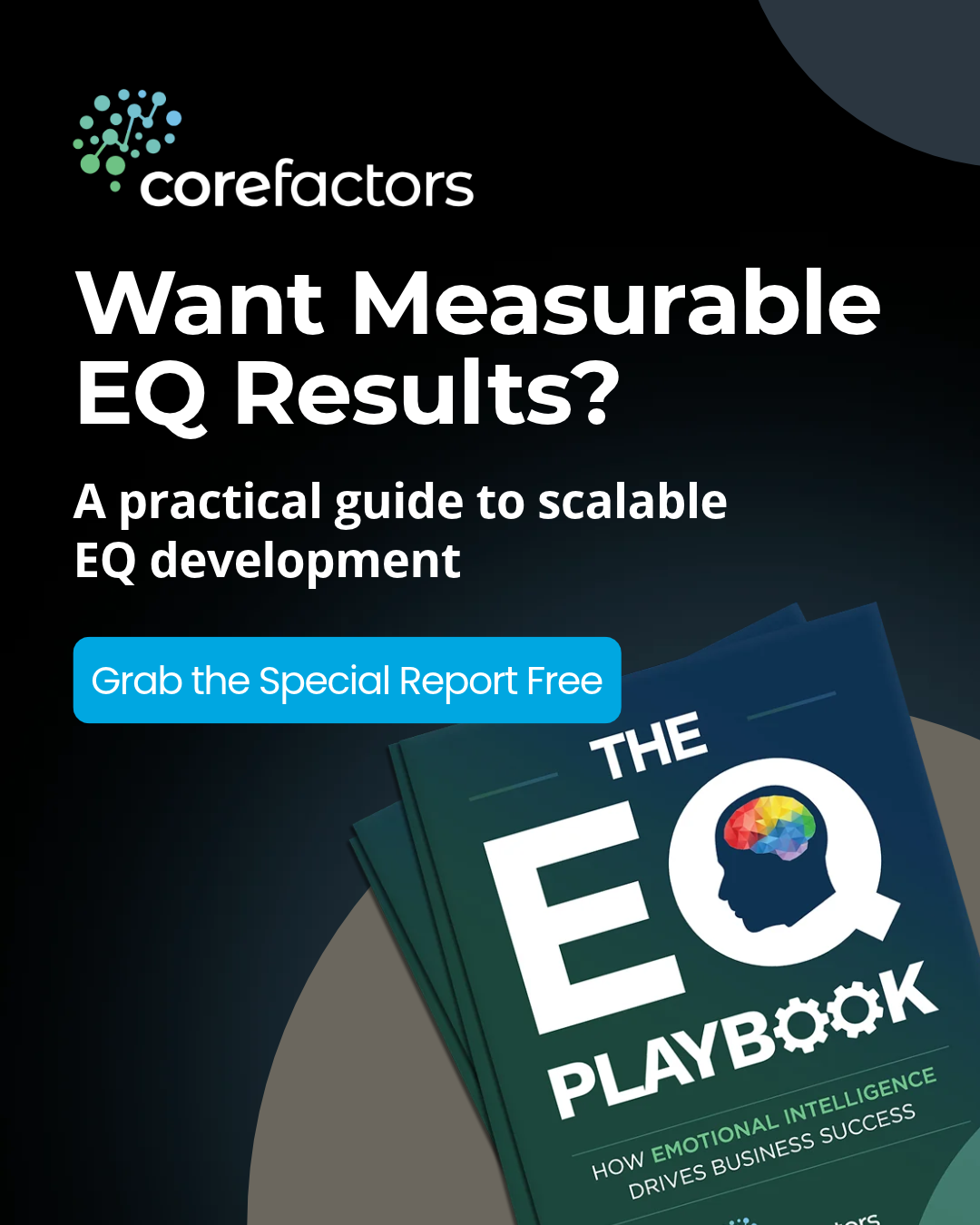

Core Factors Special Reports on emotional intelligence, workplace communication, and career development are now free downloads with no form to complete.
TEMECULA, CA, UNITED STATES, November 25, 2026 /EINPresswire.com/ — Core Factors, a people-development platform for coaches, consultants, and HR professionals, today made its Special Reports available as free downloads with no form to complete. The Special Reports are guides for practitioners who introduce emotional intelligence, workplace communication, and career development programs to their clients and organizations. Among the Special Reports, The EQ Playbook addresses how to assess and develop emotional intelligence in an organization. The Communication Advantage addresses communication, conflict, and delegation through the Core Factors Social Dynamics model. Personalizing Career Development addresses career conversations and talent decisions through Career Path results. Each report now downloads directly as a PDF, and readers are welcome to share any report with a client, on a website, or on social media.
Each report explains a subject practitioners are often asked to justify: why emotional intelligence matters to performance, why people communicate differently, and why career development begins with what a person prefers and avoids.
The EQ Playbook: How Emotional Intelligence Drives Business Success is a 19-page Special Report on assessing and developing emotional intelligence in an organization. The report compares three established models of emotional intelligence, the Mayer-Salovey-Caruso, Goleman, and Bar-On models, so a practitioner can show a client the three models side by side. The report also describes a method for choosing which skills to develop first, based on the difference between how important a skill is and how effectively a person uses that skill, and a four-step plan for an EQ program that closes with assessing the program’s impact.
The EQ Accelerator® is a self-report emotional intelligence assessment that Core Factors publishes and Roger R. Pearman, Ed.D., developed. The assessment covers 40 emotional intelligence skills in four dimensions: Self-Awareness, Other Awareness, Self-Regulation, and Other Engagement. A participant rates every skill twice on a seven-point scale, once for the Importance of the skill and once for the participant’s Effectiveness in the skill. The assessment scores the gap between Importance and Effectiveness for each skill, and a skill weighting settles a tie between two gaps. The report then highlights one skill in each dimension, so the participant and the practitioner begin development with four specific skills. For each highlighted skill, the report describes the behaviors of people who are talented at the skill and provides two action tips to practice.
The Communication Advantage is an 18-page Special Report on workplace communication, built on the Core Factors Social Dynamics model. The report explains why conflict arises between people with different Social Dynamics styles, shows how leaders can shift the way they communicate and delegate for each style, and sets out a four-step plan for bringing the model into an organization’s development programs.
Social Dynamics is the Core Factors model and assessment that shows people how to connect and collaborate with anyone. The model describes four Social Dynamics styles: Movers, Involvers, Mappers, and Integrators. Each style is a pattern with five parts that can be identified and described: a core drive, a desired result, a decision-making approach, strengths, and typical behaviors. The model also distinguishes three selves in every person: the natural self, the developed self that a person has learned, and the situational self that a role requires. Two dimensions show what each style has in common with its neighboring styles: how a person prompts others to act, and where a person’s attention goes during an interaction. A participant confirms a core style through a series of self-discovery activities, and the assessment result is one piece of information in that process. Scott Campbell created the model, and Mark S. Majors, Ph.D., developed the assessment.
Personalizing Career Development is a 22-page Special Report on using Career Path results in career conversations and talent decisions. The report shows how a client’s Preference and Avoidance results can open a career conversation, gives structure to work with people who are returning to work, changing careers, or reassessing after burnout, and describes applications in internal mobility, succession planning, and higher-education advising.
Career Path and Career Signals® are the two Core Factors career assessments, and Mark S. Majors, Ph.D., developed the items and the scoring for both. Career Path addresses the work a person is drawn to and the work a person would choose to avoid. A participant rates 93 items, and the results report Preference and Avoidance separately for each of the eleven Occupational Activity Groupings (OAGs). Each OAG is a group of related work tasks and activities. The results also report the six Global Interest Areas (GIAs) and a three-letter GIA code that connects the participant’s interests to occupations in the O*NET database. Career Signals addresses what a person values in a career and which skills motivate the person. The assessment sorts career values into four levels, from Valued to Not Valued, and places each skill in one of four zones: Motivated Skills, Development Opportunities, Burnout Skills, and Avoid Skills. The zones compare how much a person enjoys a skill with how proficient the person is, so a skill that a person performs well and finds draining appears in the results.
Each of the three reports includes guidance for introducing the topic across an organization. The EQ Playbook and The Communication Advantage each set out a four-step plan, and Personalizing Career Development describes applications in internal mobility, career pathing, and succession planning.
Core Factors is also adapting content from the Special Reports into articles on its blog, so practitioners can find individual topics through search.
The Special Reports are available now on the Core Factors website. If you coach leaders, facilitate teams, advise people on their careers, or design development programs, download The EQ Playbook, The Communication Advantage, and Personalizing Career Development, and share the reports with anyone who will use them. Two further Special Reports by Mark S. Majors, Ph.D., Why Does the Personality Instrument Matter? and OMG! Not Another Career Assessment, are available on the same terms. Practitioners who want to work with the assessments behind the reports, which are the EQ Accelerator, Social Dynamics, Career Path, and Career Signals, can create a free Pro Account. Practitioners can also request a demo and take an assessment themselves before they administer the assessment to a client.
About Core Factors
Core Factors is a people-development platform for practitioners. Executive coaches, OD consultants, L&D professionals, HR professionals, and career practitioners use Core Factors to administer assessments and diagnostics, deliver results, reinforce development between sessions, and document outcomes through participant feedback and reporting.
The assessment portfolio includes Type Discovery, Type Elements, and Type Dynamics for psychological type work across decision-making, learning, leadership, and interpersonal effectiveness. EQ Accelerator guides emotional intelligence development with a structured focus on priority skills and growth sequencing. Social Dynamics addresses interaction styles and their applications across communication, collaboration, influence, and conflict. Career Path and Career Signals support career alignment through occupational fit mapping and values-based career planning. Brain Agility Lens supports development conversations focused on cognitive resources, agility, and the people skills they connect to.
Smarts Diagnostics extend the platform to teams and organizations. Group Lead benchmarks a team against highly effective teams and identifies strengths and areas of needed focus in the team’s effectiveness. Business Smarts, Strategic Smarts, and Marketing Smarts gather ratings of leadership behavior from across an organization and benchmark business performance, strategy, and marketing against the industry.
Every assessment and every diagnostic is supported by the Participant Hub. In the Participant Hub, participants access results, explore model content, engage with structured reflection, and receive developmental guidance from Evidentra®. Team Members and stakeholders review diagnostic results in the Participant Hub and set action priorities together. Evidentra is the Core Factors AI Coach Assistant. Core Factors is built on a commitment to psychometric integrity, ethical application, and practical results for the practitioner and for the people, teams, and organizations they develop.
Kris Kiler
Core Factors
+1 844-989-5323
Visit us on social media:
LinkedIn
Instagram
Facebook
YouTube
Legal Disclaimer:
EIN Presswire provides this news content “as is” without warranty of any kind. We do not accept any responsibility or liability
for the accuracy, content, images, videos, licenses, completeness, legality, or reliability of the information contained in this
article. If you have any complaints or copyright issues related to this article, kindly contact the author above.

Media gallery